

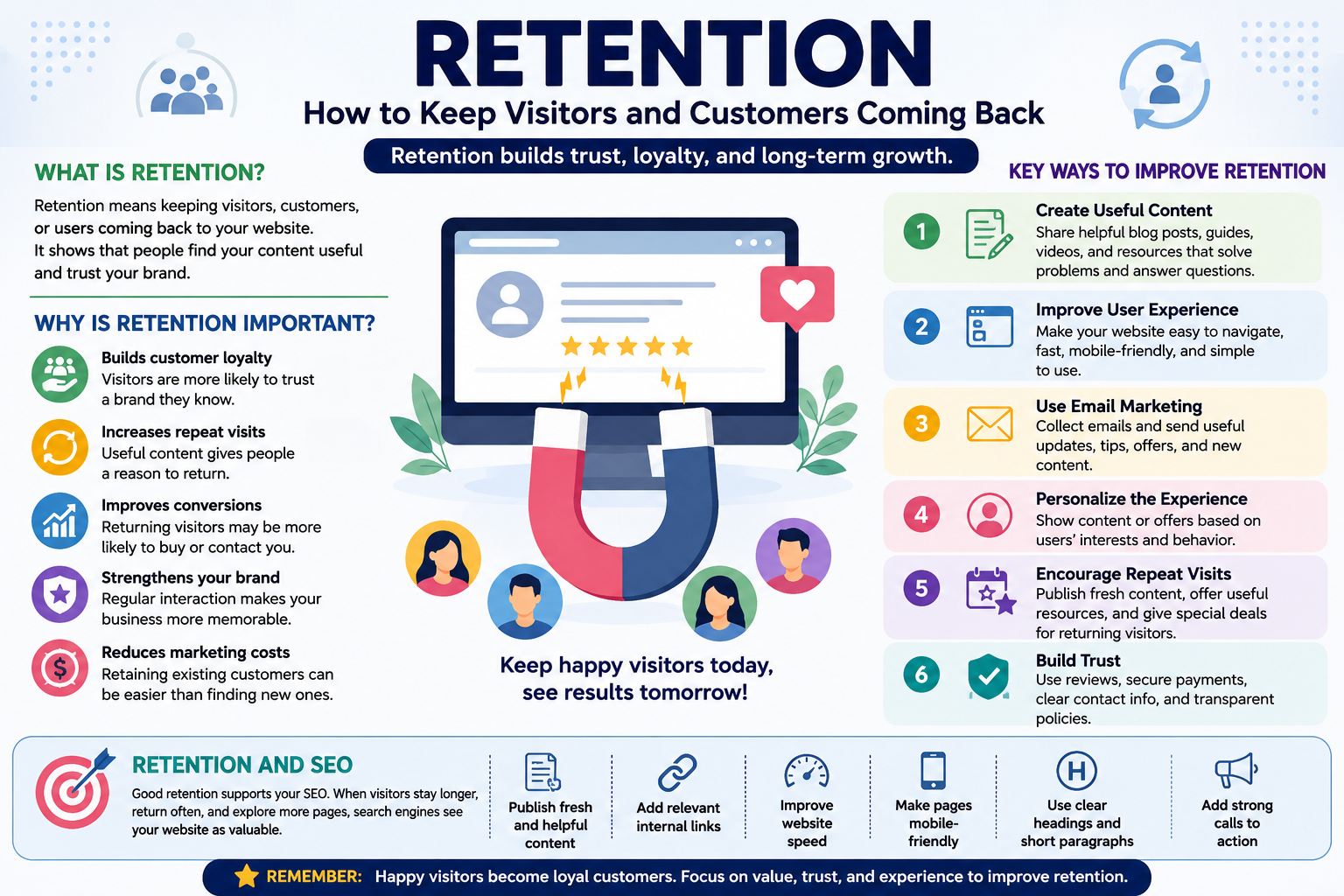
What Is Retention in Digital Marketing?
Retention in digital marketing is the process of keeping existing customers engaged with a brand so they continue to buy products, use services, visit a website, or interact with the business over time. Instead of focusing only on attracting new customers, retention marketing aims to build long-term relationships with people who have already shown interest in or purchased from a business.
Customer retention is important because acquiring a new customer can often require significantly more marketing effort than encouraging an existing customer to return. A strong retention strategy can increase customer lifetime value, improve loyalty, generate repeat purchases, and create opportunities for referrals.
What Does Customer Retention Mean?
Customer retention refers to a company’s ability to keep customers over a specific period.
For example, imagine an online clothing store has 1,000 customers at the beginning of the year. If many of those customers continue purchasing from the store throughout the year, the business has achieved a strong retention rate.
Digital marketing supports retention by maintaining communication and providing reasons for customers to remain connected with the brand.
Common retention channels include:
- Email marketing
- SMS marketing
- Push notifications
- Social media
- Loyalty programs
- Personalized offers
- Remarketing campaigns
- Content marketing
- Customer communities
- Mobile applications
Why Is Retention Important in Digital Marketing?
Retention is important because a business’s relationship with a customer should not necessarily end after the first purchase.
A customer who returns multiple times can generate substantially more revenue than someone who makes only one purchase. Returning customers may also be more familiar with the brand, making them easier to engage through personalized marketing.
Key benefits include:
1. Increases Customer Lifetime Value
Customer Lifetime Value (CLV) estimates how much revenue or profit a customer can generate throughout their relationship with a business.
When customers continue purchasing over a longer period, their potential lifetime value increases.
For example:
Customer A:
One purchase × $50 = $50
Customer B:
Five purchases × $50 = $250
A retention strategy can encourage Customer B to continue the relationship with the brand.
2. Encourages Repeat Purchases
Retention marketing gives customers reasons to return.
Businesses can use:
- Personalized recommendations
- Reorder reminders
- Special discounts
- Loyalty rewards
- Product updates
- Seasonal promotions
For example, an online grocery store might remind customers when it is likely time to reorder commonly purchased products.
3. Builds Brand Loyalty
Repeated positive interactions can turn customers into loyal supporters of a brand.
Loyal customers may:
- Purchase more frequently
- Try new products
- Recommend the brand
- Follow social media accounts
- Participate in loyalty programs
- Leave positive reviews
4. Reduces Dependence on New Customer Acquisition
Businesses that rely exclusively on new customers need to continually invest in advertising and acquisition campaigns.
Retention creates another growth opportunity: generate more value from the customers you already have.
A balanced digital marketing strategy therefore considers both acquisition and retention.
Retention vs. Acquisition
Acquisition and retention serve different purposes.
| Acquisition | Retention |
|---|---|
| Attracts new customers | Keeps existing customers |
| Focuses on first conversion | Focuses on repeat engagement |
| Uses advertising, SEO, content and social media | Uses email, loyalty, personalization and remarketing |
| Builds the customer base | Strengthens customer relationships |
| Measures new customers | Measures returning customers and churn |
A successful business generally needs both.
Acquisition brings customers in. Retention gives them reasons to stay.
What Is a Retention Rate?
The customer retention rate measures the percentage of customers a business retains during a particular period.
A commonly used formula is:
Retention Rate = [(Customers at End of Period − New Customers Acquired) ÷ Customers at Beginning of Period] × 100
Example
Suppose an online business starts the month with 500 customers.
By the end of the month, it has 550 customers. During that month, 100 new customers were acquired.
Retention Rate:
[(550 − 100) ÷ 500] × 100 = 90%
The business retained 90% of its original customers during the period.
What Is Churn?
Churn is the opposite side of retention.
Customer churn occurs when customers stop purchasing, cancel a subscription, stop using a service, or otherwise discontinue their relationship with a business.
For subscription businesses, churn is particularly important.
For example, if 1,000 subscribers start a month and 50 cancel, the business has experienced a 5% customer churn rate for that period, assuming the calculation uses the starting customer base.
Reducing churn is one of the central goals of retention marketing.
Common Digital Marketing Retention Strategies
1. Email Marketing
Email remains one of the most useful channels for maintaining relationships with existing customers.
Businesses can send:
- Welcome emails
- Product recommendations
- Personalized offers
- Re-engagement emails
- Educational content
- Loyalty rewards
- Abandoned-cart reminders
- Renewal notifications
The goal is not simply to send more emails. The goal is to send relevant messages at the right time.
2. Personalization
Personalized marketing uses customer information and behavior to make communications more relevant.
For example, an ecommerce business could recommend products based on:
- Previous purchases
- Browsing behavior
- Categories viewed
- Purchase frequency
- Customer preferences
Personalization can make customers feel that the brand understands their needs rather than treating every customer identically.
3. Loyalty Programs
Loyalty programs reward customers for continued engagement.
Rewards might include:
- Points
- Discounts
- Exclusive products
- Early access
- Free shipping
- Special memberships
- Birthday rewards
A well-designed loyalty program gives customers an additional reason to return.
4. Remarketing
Remarketing allows businesses to reconnect with people who have previously interacted with their website, app, or other digital properties.
For example, someone who viewed a product but did not purchase might later receive a relevant advertising message.
Remarketing can help bring potential customers back into the purchasing journey.
5. Content Marketing
Useful content can keep customers connected to a brand even when they are not immediately ready to buy.
Examples include:
- Tutorials
- Guides
- Videos
- Case studies
- Product education
- Industry insights
- How-to articles
Good content provides value instead of constantly asking customers to make a purchase.
6. Social Media Engagement
Social media can help brands maintain an ongoing relationship with customers.
Businesses can use social platforms to:
- Answer questions
- Share useful content
- Announce new products
- Highlight customers
- Run communities
- Collect feedback
- Respond to comments
The focus should be on meaningful engagement rather than simply increasing follower counts.
7. Customer Support
Customer experience has a direct relationship with retention.
Fast and helpful support can prevent customers from leaving after experiencing a problem.
Digital support can include:
- Live chat
- Email support
- Help centers
- Chatbots
- Knowledge bases
- Social media support
Retention marketing works best when marketing promises are supported by a good overall customer experience.
Retention Metrics to Track
Businesses can monitor several metrics to determine whether their retention strategy is working.
Customer Retention Rate
Shows how effectively a business keeps customers over a specific period.
Customer Churn Rate
Measures the percentage of customers who leave or become inactive.
Repeat Purchase Rate
Shows how many customers make more than one purchase.
Customer Lifetime Value
Estimates the value a customer generates throughout the relationship.
Purchase Frequency
Measures how often customers purchase within a particular period.
Average Order Value
Shows the average amount spent per transaction.
Engagement Rate
Measures interactions with marketing communications, such as emails, apps, or social media.
Reactivation Rate
Measures how successfully inactive customers are brought back.
Retention Marketing Example
Consider an online skincare store.
A customer purchases a moisturizer for the first time.
Instead of ending communication after the sale, the business could:
- Send a purchase confirmation.
- Provide instructions for using the product.
- Send educational skincare content.
- Recommend complementary products.
- Offer a loyalty program.
- Send a reminder when the moisturizer may be running low.
- Provide a personalized offer.
- Ask the customer for a review.
- Re-engage the customer if they become inactive.
This creates a continuous customer journey rather than treating the first purchase as the end of the relationship.
How to Improve Customer Retention
A practical retention strategy can follow these steps:
Step 1: Understand Your Customers
Analyze purchasing behavior, engagement, demographics where appropriate, and customer feedback.
Step 2: Segment Your Audience
Divide customers into meaningful groups, such as:
- New customers
- Repeat customers
- High-value customers
- Inactive customers
- Frequent buyers
- Customers at risk of churning
Different groups may require different messages.
Step 3: Personalize Communication
Use customer behavior to deliver more relevant content, recommendations, and offers.
Step 4: Create a Post-Purchase Experience
Don’t stop communicating after a customer buys. Help them get value from their purchase.
Step 5: Reward Loyalty
Give returning customers meaningful benefits that encourage continued engagement.
Step 6: Identify Churn Signals
Look for signs such as declining purchase frequency, reduced engagement, subscription cancellations, or prolonged inactivity.
Step 7: Test and Optimize
Experiment with:
- Email subject lines
- Offers
- Timing
- Content
- Landing pages
- Loyalty rewards
- Messaging
Then measure which approaches produce better retention.
Retention in Different Types of Businesses
Retention strategies vary depending on the business model.
Ecommerce
Focus on repeat purchases, product recommendations, loyalty programs, personalized emails, and replenishment reminders.
SaaS
Software companies often focus on onboarding, product adoption, customer education, support, and reducing subscription churn.
Subscription Services
Subscription businesses need to demonstrate ongoing value and provide effective cancellation-prevention and re-engagement experiences.
Content Websites
Publishers can encourage visitors to return through newsletters, useful content, notifications, and personalized recommendations.
Mobile Apps
Apps can use onboarding, push notifications, personalized experiences, rewards, and product improvements to encourage continued usage.
Retention and SEO
Retention can also indirectly support an SEO strategy.
When users repeatedly return to a website, they may consume more content, subscribe to newsletters, share resources, or become customers. High-quality content that solves users’ problems can encourage repeat visits while also supporting organic search visibility.
However, customer retention and SEO are not the same thing. SEO primarily helps attract relevant organic traffic, while retention focuses on keeping customers or users engaged after the initial interaction.
A strong digital strategy can combine both:
SEO → Traffic → Conversion → Engagement → Retention → Loyalty → Advocacy
Retention vs. Engagement
These concepts are related but different.
Engagement describes how actively someone interacts with a brand.
Retention describes whether that person continues their relationship with the brand over time.
For example, someone might open several emails but never purchase again. That represents engagement without necessarily representing successful customer retention.
Final Thoughts
Retention in digital marketing is about building lasting customer relationships rather than focusing exclusively on first-time conversions. Businesses can improve retention through personalized communication, valuable content, loyalty programs, remarketing, excellent customer support, and consistent customer experiences.
The most effective retention strategy starts with understanding why customers return—and why they leave. By monitoring retention rate, churn, repeat purchases, customer lifetime value, and engagement, businesses can identify opportunities to create stronger relationships and sustainable long-term growth.





Leave a Reply